
[bt_section][bt_row][bt_column width=»1/1″][bt_hr top_spaced=»topSpaced» bottom_spaced=»not-spaced» transparent_border=»noBorder» el_class=»» el_style=»» responsive=»»][/bt_hr][/bt_column][/bt_row][/bt_section]

proyectolechuza.gif

12 julio, 2021 AnimalsNews0


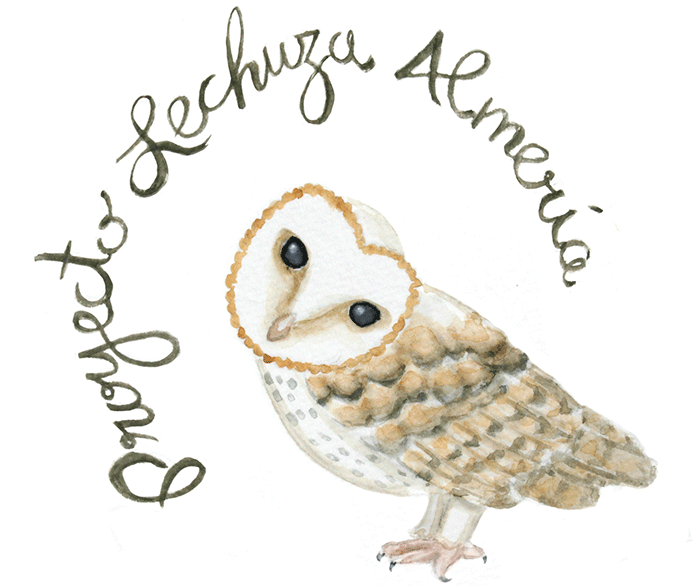
For the fourth consecutive year, Oasys MiniHollywood has once again collaborated in the Lechuza Project, together with the CECOUAL of the University of Almería, the Society for the Study and Recovery of Almeria Biodiversity (SERBAL), the Group for the Rehabilitation of Autochthonous Fauna and its Habitat (GREFA) and the Rodalquilar Botanical Garden.

The common owl (Tyto alba) is included in the List of Wild Species in the Special Protection Regime at the national level, since its populations have been affected by the degradation of its habitat and the disappearance of sustainable agriculture, progressively increasing the area of ​​development of industrial agriculture and use of chemical products that in turn cause the disappearance of the natural prey of these birds.

The common owl was a common bird in the province of Almería and in recent years it has suffered a significant decline in its populations, disappearing in some municipalities.

For this reason, from Oasys MiniHollywood together with CECOUAL and SERBAL, this Project of Reintroduction of the Common Owl has been carried out for several years by means of the hacking technique (nest boxes), monitoring by cameras both inside and outside of these, the development of the chicks, their flight practices, feeding, and finally flying further and further away from the nest to look for food, until once established in their new territory, they will stop coming back to colonize new areas and reinforce the indigenous population.


In this way, Oasys MiniHollywood collaborates with the Lechuza Project to reinforce the population of this species in the province of Almería.


You can follow the live project here:

Twitch CECO UAL


225-baja-aquarium-manta-raya.jpg

28 junio, 2021 Animals0

A few weeks ago in one of our Stingray (Pteroplatytrygon violacea) specimens, weighing more than twenty kg that lives in the central tank of the Aquarium Costa de Almería (Roquetas de Mar), began to become visible a portuberance on the edge of the fin left side, which bothered him in his daily life as he was looking for surfaces to rub against that end.

Therefore, the veterinary team decided to prepare the material and surgical procedure to be able to remove this mass. In addition to the Aquarium’s aquarists and technicians, the intervention was attended by its veterinarian and director of Oasys MiniHollywood, Jose María Rodríguez Linde and the specialist dermatologist, Patricio López Jiménez.

The main complication was to have a support in which the animal, when it was out of the aquatic environment, could continue to breathe the oxygen contained in the water, through the gills.

Another important factor was to medicate that water with anesthetics that allowed the animal to be sedated during the entire time of the intervention to avoid any possible discomfort derived from the operation.

All this was achieved with two tanks, one medicated and the other with clean water without a sedative product for the recovery period after surgery.

Likewise, in the surgical intervention stretcher, in addition to having enough humidity so that the animal’s skin did not suffer dehydration at any time, a pumping system was available to provide water with anesthetic in the animal’s own oral cavity.

The operation was a success and within a few days she was already swimming in the central tank of the Aquarium, where he can be seen fully recovered.

Oasys MiniHollywood and Aquarium Costa de Almería, together for Animal Welfare.


oknacimiento-gemelos-gacela-cuvier-800x533-1.jpg

28 abril, 2021 Animals0


Oasys MiniHollywood signed last week the renewal of an agreement with the CSIC for the conservation of four threatened species: dama gazelle (Nanger dama mhorr), Cuvier’s gazelle (Gazella cuvier), dorcas gazelle (Gazella dorcas neglecta) and aruís (Ammotragus lervia sahariensis).

This project began in 2001, together with the CSIC’s Arid Zones Experimental Station (EEZA), with the transfer to our zoological reserve of four Dorcas gazelles and four Cuvier’s gazelles. Nowadays, the park already houses a breeding group of dama gazelle, a group of male gazelle dama, a group of male dorcas gazelle and two male Cuvier’s gazelle.

The objective of this agreement is the optimal conservation of threatened animal species and subspecies, especially those mentioned above. Thus, Oasys MiniHollywood offers the necessary space, food and optimal health care. In addition, the park will bear the necessary expenses to maintain the best conditions and security and, of course, any need that may appear to each individual.

This agreement will have a duration of four years, being able to be extended again for a maximum of another four years.

In addition to this, Oasys MiniHollywood participates in multiple other projects for the captive breeding of extinct or seriously endangered species, as in this case, so that in the future it will be possible to reintroduce them in their free environment.